
A 911 Call, a Contempt Case and a Fight Over Judicial Accountability in Lake Charles
John and Shunte King challenge Judge Ronald C. Richard’s handling of their case, alleging denied medical accommodations and improper contempt proceedings.
A dispute over a vehicle title became a much broader battle for John and Shunte King: a challenge to how a Louisiana courtroom handled disability accommodations, a reported medical emergency and a wife’s decision to call 911.
Three case summaries dated October 2026 describe the couple’s allegations against Lake Charles City Court Judge Ronald C. Richard. The documents, prepared to present their case and support further review, recount a contested property transfer, courtroom confrontations and subsequent legal proceedings.
They also leave important questions unresolved. The documents are summaries and legal arguments, rather than the complete underlying record. And a published appellate decision supplies a significant outcome that the summaries do not clearly explain: although the Kings describe winning relief over certain post-trial orders, John King lost his appeal of the original notary lawsuit.
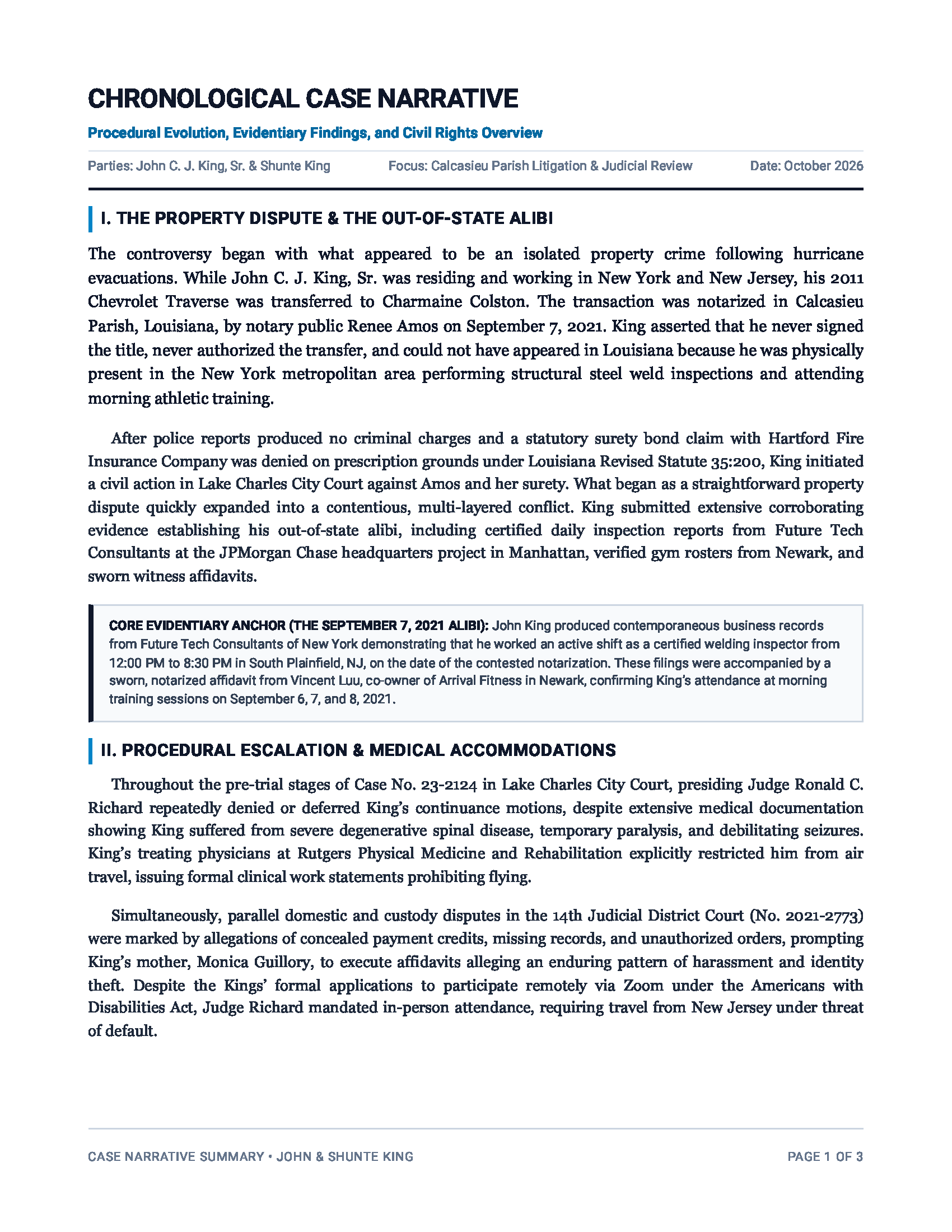
The dispute began with the transfer of King’s 2011 Chevrolet Traverse in September 2021. According to the supplied narrative, King maintained that he never signed or authorized the transaction notarized by Renee Amos in Calcasieu Parish. He said he was working in the New York metropolitan area at the time, and the narrative describes employment records, gym attendance records and affidavits supporting his account.
King sued Amos, arguing that she had improperly notarized the transfer.
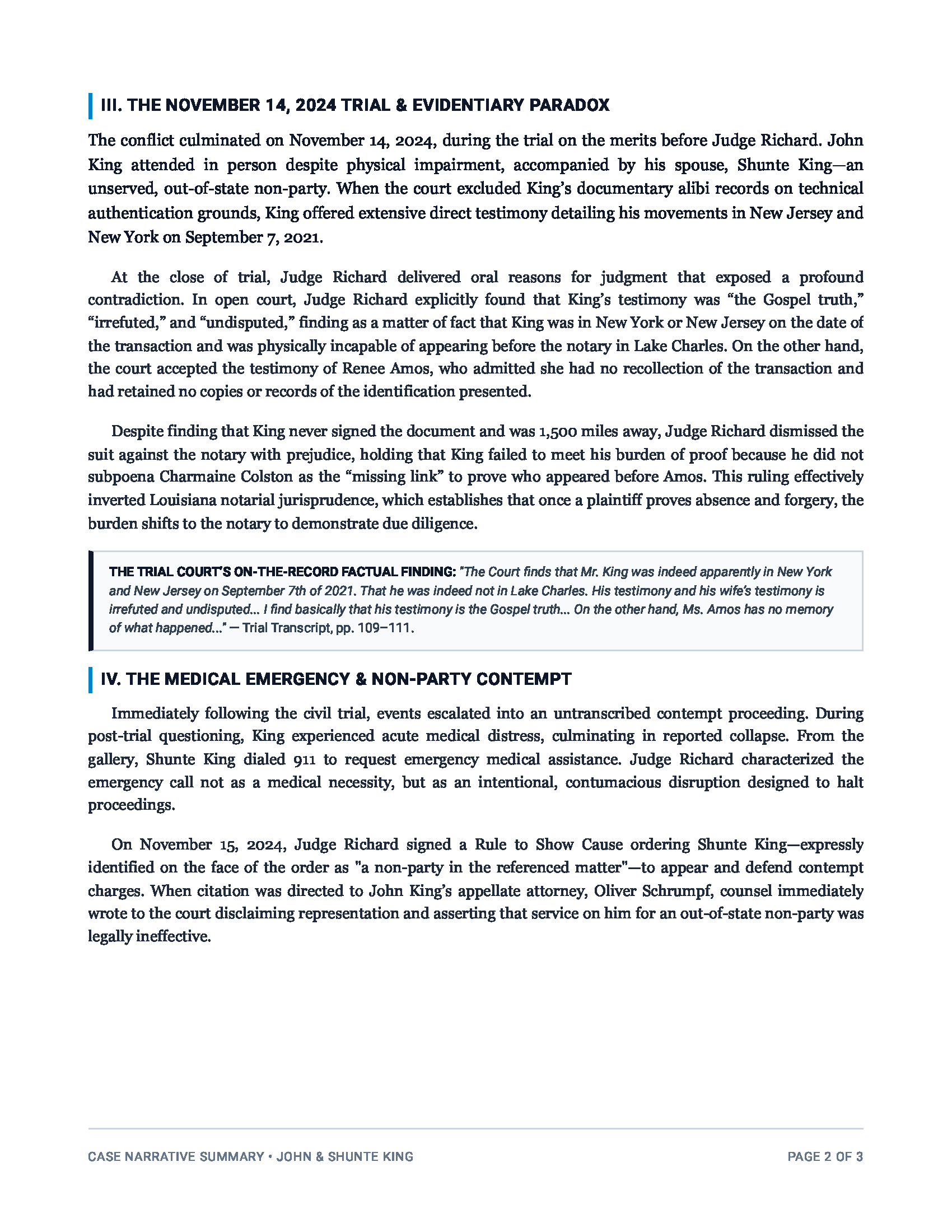
At the November 14, 2024, trial, Richard accepted that King had been outside Louisiana when the transaction occurred. Nevertheless, the judge dismissed the lawsuit, finding insufficient proof of wrongdoing by Amos.
On May 21, 2025, Louisiana’s Third Circuit Court of Appeal affirmed that dismissal. Its opinion explained that Amos testified about checking identification and her customary verification practices. The appellate court found that King had not established negligence or deliberate misconduct and noted that an impersonator using false identification was a possible explanation. The court also considered the absence of testimony from the vehicle’s recipient, Charmaine Colston, significant. Read the appellate opinion in King v. Amos.
That decision limits the supplied audit’s characterization of the notary ruling as an established legal violation. The Kings’ disagreement with the outcome remains part of their account, but the dismissal survived appellate review.
Their allegations about what happened after the trial concern a separate set of events.
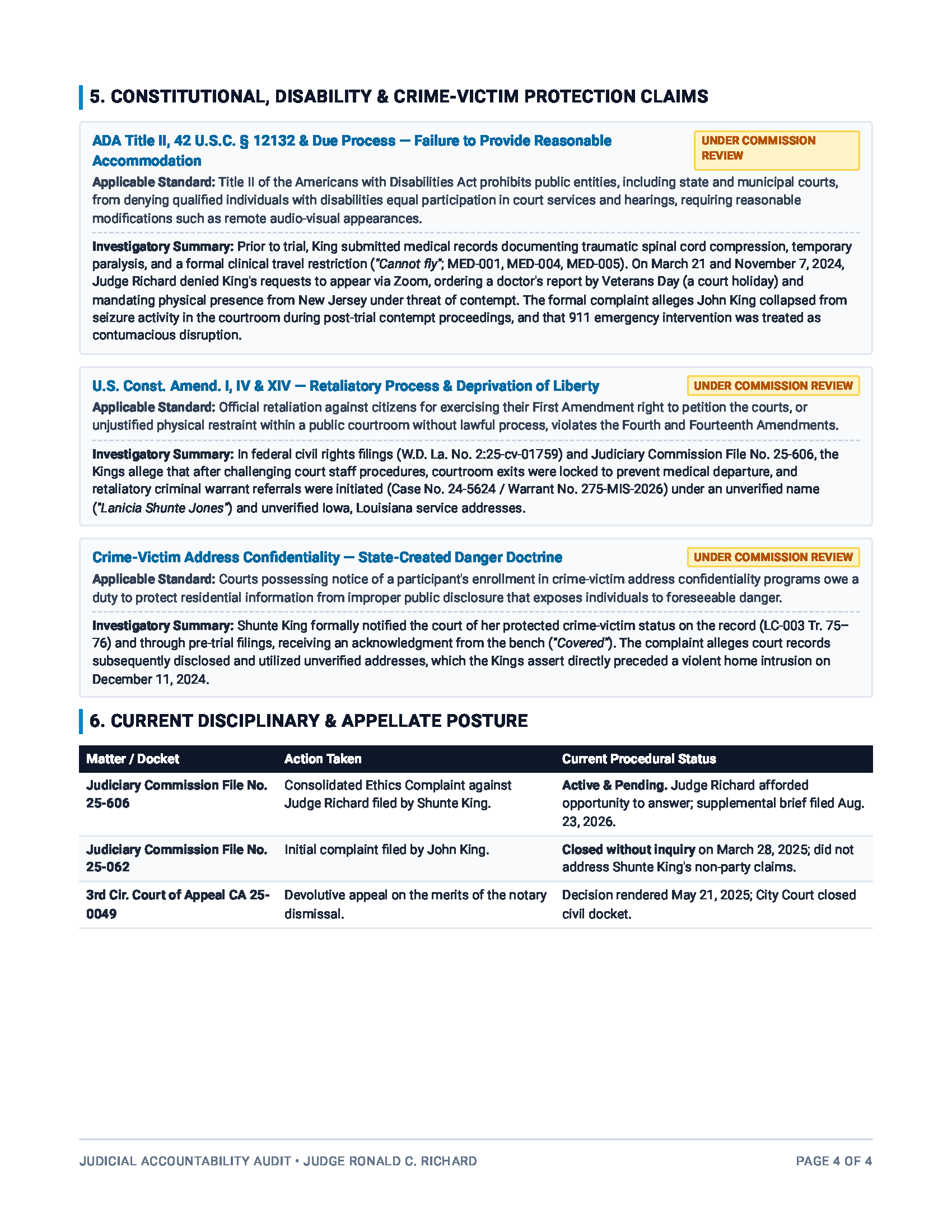
According to the supplied documents, John King had serious spinal problems and episodes involving seizures and temporary paralysis before traveling to Louisiana. The summaries describe medical statements restricting air travel and requests to participate remotely that the court denied.
The Kings say that, during post-trial contempt questioning, John experienced severe distress and collapsed. Shunte called 911 from the courtroom gallery. Their account alleges that requests for medical breaks were denied and that bailiffs prevented departure.
Richard’s position, as reproduced in the supplied brief, was sharply different. The contempt rule accused Shunte of deliberately calling 911 to interrupt questioning and remove her husband from the courtroom. The brief also attributes a later statement to Richard describing the reported seizure as a “complete lie and a fabrication.”
These competing accounts are central to the dispute. The materials reviewed do not independently establish what happened during the reported emergency.
The brief says the certified trial transcript ends before the post-trial contempt proceeding. It identifies courtroom recordings, 911 dispatch records and emergency medical reports as evidence needed to evaluate whether Shunte sought necessary medical assistance or intentionally disrupted proceedings.
The documents also challenge how the court pursued contempt against her. They reproduce an order identifying her as a non-party and describe attempted service through John’s appellate lawyer, Oliver Schrumpf. According to the brief, Schrumpf notified the court that he did not represent Shunte in the contempt matter and that service on him was ineffective.
The supplied audit argues that the proceedings contained jurisdictional and notice defects. Those arguments should be distinguished from a judicial ruling resolving them; the materials do not include such a ruling on Shunte’s contempt case.
A separate procedural dispute did reportedly produce appellate relief.
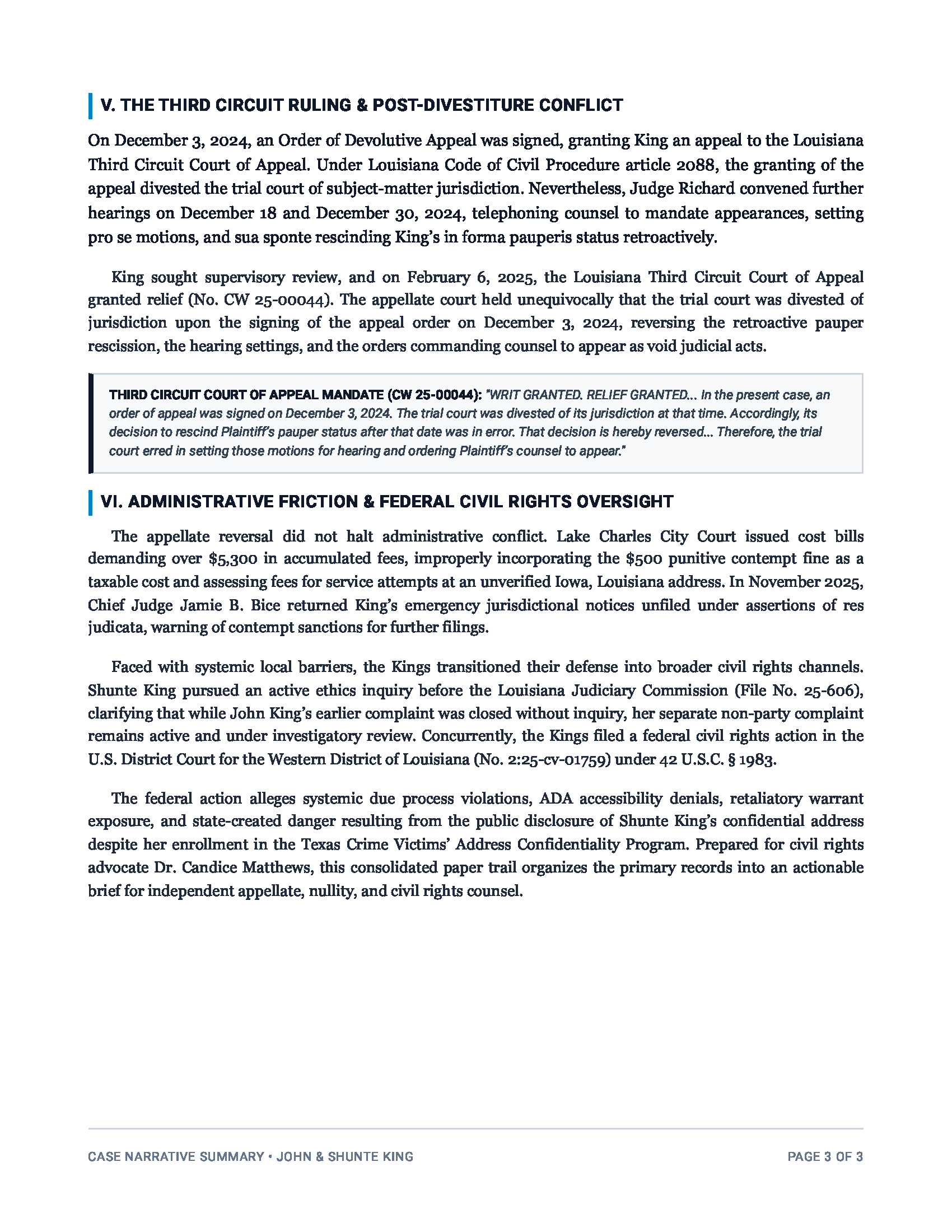
The narrative reproduces language from a February 6, 2025, Third Circuit ruling reversing the revocation of John’s permission to litigate without prepaying court costs and rejecting certain hearing settings and orders requiring counsel to appear after an appeal had been granted. The underlying ruling was not independently verified for this article. As described, it addressed particular post-appeal actions, rather than deciding the Kings’ broader misconduct allegations.
The couple’s complaints subsequently expanded to include disputed court charges, alleged retaliation and the handling of Shunte’s protected address information. The documents identify a federal civil rights action and describe her judicial ethics complaint as pending as of October 2026. Those current statuses have not been independently confirmed, and the supplied materials contain no final finding establishing those allegations.
No response from Richard was obtained for this article. His position on the 911 incident is represented here through statements reproduced in the supplied documents.
For the Kings, the unresolved issue extends beyond the vehicle that first brought them to court. Their account raises a concrete question about the treatment of a reported medical emergency during judicial proceedings. Answering it requires the underlying recordings, emergency-response records and complete court filings—evidence that could test both the couple’s allegations and the court’s stated reasons for pursuing contempt.
Case Narrative Documents
Legal Audit


The 911 Contempt Matter

